
Yannis Fikas, Founder and President of the Academy of Farsala-Giordano Bruno, his place in the history of philosophy and ideas

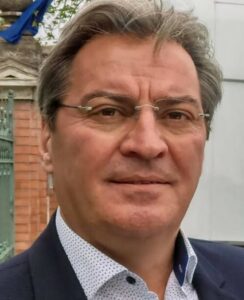
Yannis Fikas is Founder and President of the Academy of Farsala.
He is Journalist of F.I.J.E.T., Fédération Internationale des Journalistes et Ecrivains du Tourisme.
He was Director of Humanities at BCA College from 2020 to 2023, Director of Corporate Relations & Cooperative Education at New York College and Professor of Philosophy at the State University of New York/ Empire State College from 2012 to 2019, Executive Director for Learning Technologies at the American College of Greece from 1995 to 2011 and a visiting Professor of Renaissance Philosophy in the Master Programme in Philosophy of the University of Athens from 2001 to 2008.
He holds a bachelor’s degree in Computer Science from the University of Patras and a Ph.D. in Philosophy from the University of Athens.
He is the author of eight books with philosophical and anthropological content:
- The Myths of the ancient World Athens, M. Sideris, 2019.
- The City in time and space, Art, Philosophy, Politics, Athens, M. Sideris, 2018.
- Philosophy & Leadership, Athens, M. Sideris, 2017.
- World, City and Man, Philosophical texts, Athens, Nikas, 2016.
- Giordano Bruno, His Place in the History of Philosophy and Ideas, Athens, Nikas, 2012.
- Paths of Art and Wisdom, Athens, Nikas, December 2010.
- Art and Culture of Ancient World, Athens, Karakotsoglou, 2005.
- Myths and Communications, Athens, Nikas, 2003.
- Giordano Bruno, His Place in the History of Philosophy and Ideas, Athens, Ellinika Grammata, 2000.

Summary: The aim of this paper is to present the Renaissance philosopher Giordano Bruno. According to Giordano Bruno, a human being is threefold composed of a body (soma), soul (psyche) and spirit (nous). Bruno’s philosophical theory on the harmonization of the soul with the mind (nous) and the body focuses mainly on the shaping of the psychological world through the development of imagination and memory. Bruno’s works deal with the “Art of Memory”, which elevates and gradually extends the consciousness of the disciple of wisdom from the earthly world to the extending boundaries of the starry sky. Bruno supports that humans who process the images of ideas through their imagination can approach the same archetypical ideas found within the divine mind and then embody them without distortions to the material world. These images constitute the best guides to the soul, because they elevate consciousness and facilitate its entry and access to the archetypical ideas found in the universal intellect. As these images dim the light, they prepare the eyes of the soul which are still wrapped in fog to gradually face the very same ideas.
The characteristics of the historical period called The Renaissance appear in Italy in the 14th century AD and last until the 16th century AD. Within this period a total renewal of philosophy, science, art and civilization takes place. Renaissance ideas are not theocentric like the ones in the Middle Ages, but focus mainly on humans, city and nature. A new society characterized by mobility and conquest succeeds the static society of the Middle Ages with the strict secular and religious authority.
The Renaissance human is able to arrange his life, shape his future and change his environment through the development of his personal virtues. The representatives of that new Renaissance spirit wanted to overcome the contradictions and conflicts of their times in order to create a better world. That need for change urged them to seek for ideals in the classical world. Literature, arts, science, politics and philosophy were cultivated. The ancient intellect returned through philosophy; while myths and symbols reappeared through art and mainly painting.




 kultapogeum 2021 Toate drepturile rezervate